Ireland Spring 2026

.

.

IRELAND REGION

.

Regional Contact member – Matthew Kehoe

.

I hope everyone is having a productive lambing season and taking all of the usual trials

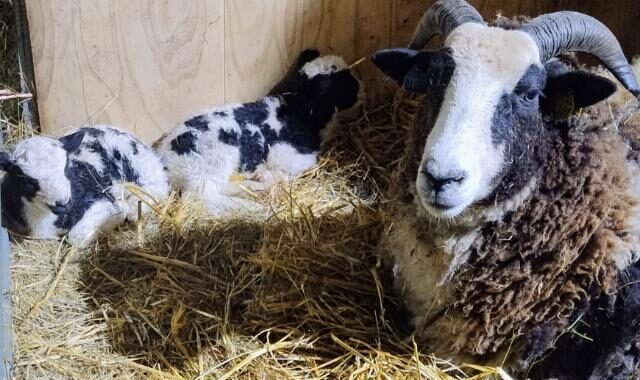
and tribulations in their stride. At home here at the Macamore flock we have had a brief but very busy eight days of lambing some early synchronised ewes in January and are preparing for the main batch to begin around the 1st of March.

.

Since the previous edition of the Jacob Journal we have held our regional AGM on the

18th of October at the Bailie Hotel, Co. Cavan, and the first of many regional committee meetings on the 25th of January at Boyne Valley Wools, Co. Meath, to begin planning for the 2026 national shows, official sales, in-lamb sales, open day, the show competition and the flock competition.

.

The 2025 In-Lamb Ewe and Ewe Lamb Sale took place on Friday the 12th of December with a full report included elsewhere in this Journal.

.

The Ireland region committee is planning to run another Ireland region flock competition around the first week of October with our two judges yet to be confirmed at the time of writing. This always proves to be a useful opportunity to gain advice and guidance from a fresh pair of eyes on your stock and flock management. While we call it a flock competition due to its competitive nature it is very much an informal flock assessment aimed at providing a service to both new and experienced breeders. As always I’d greatly encourage everyone to take part. The annual show competition will run as usual under the same rules with points collated from the exhibitors’ six most successful outings combined. Our first event of the year will be the Royal Balmoral Show held at the Eikon Exhibition Centre, Lisburn, from the 13th to the 16th of May. Following the usual schedule of events the Jacobs will be judged first thing Thursday morning by Siwan Harries (Hope and Gobaith flocks – Wales). As always Balmoral promises to be a fantastic start to the show season.
.

.
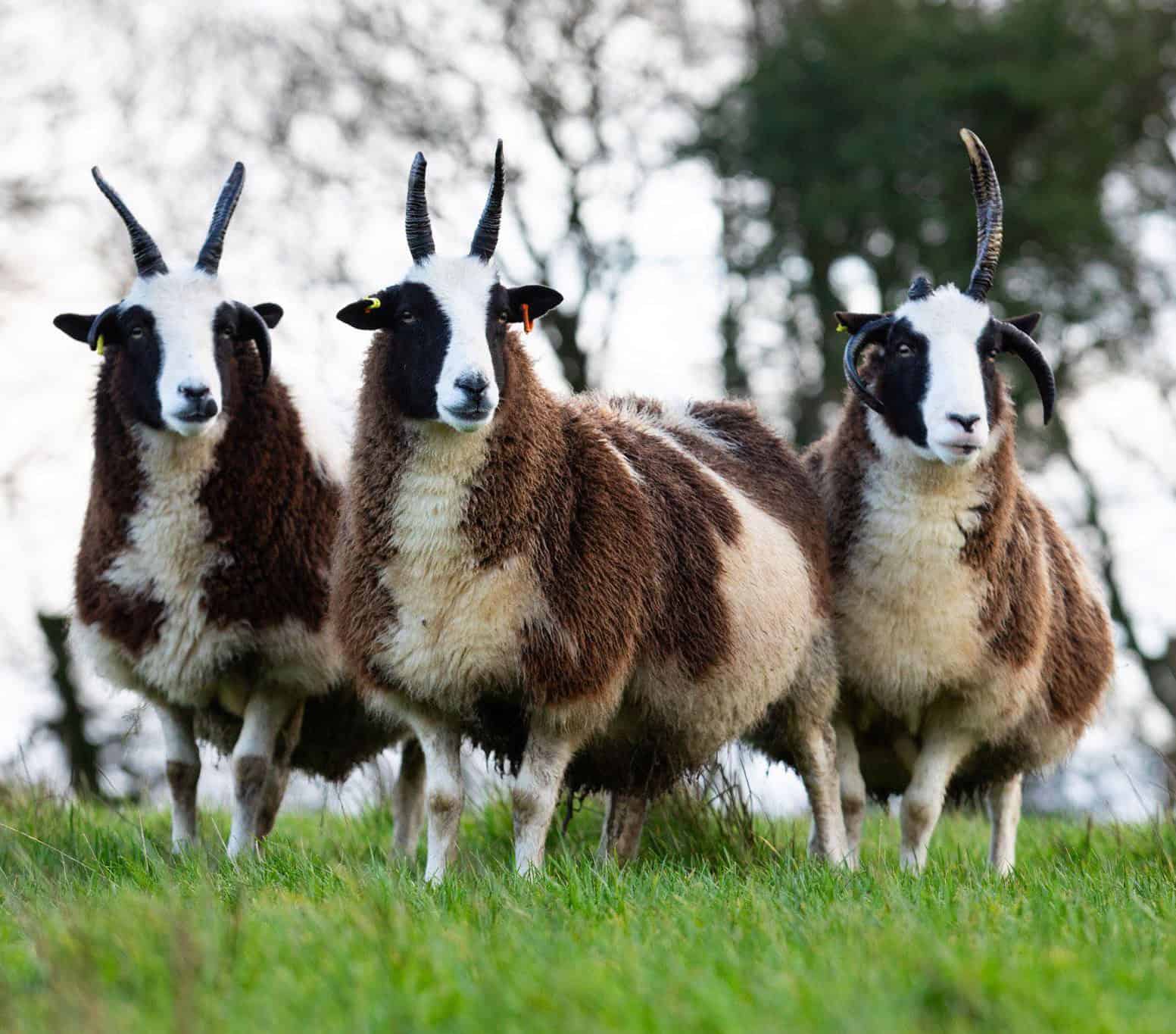
Three generations of ewe at Dabhan Harkin’s Eglish flock in Northern Ireland

.

.

.

The 2026 Jacob national shows held in conjunction with Omagh Show (Saturday 4th of

July) and Clonmel Agricultural Show (Sunday 5th of July) will both be kindly judged over

the course of the weekend by Stephen Harrison (Meathop flock – Northern region). For the Tullamore Livestock Show (Sunday 9th of August) we look forward to welcoming Lesley Partridge (Bentley flock – Central region) to judge the Jacob classes.

.

As always our local agricultural shows are continually in need of Jacob sheep entries

and sponsorship in order to maintain the breed classes so please give them every bit of support that you can over the next few months. My thanks to everyone who has already secured sponsorship and trophies for the classes at their local shows. To our judges we are always in your debt and we greatly appreciate the effort from those who travel across the water to come see us.

.

Our Southern Ireland Show and Sale will take place on Saturday the 1st of August at it’s

new venue, Tullow Livestock Mart, Tullow, Co. Carlow, and will be judged by the Society Field Officer, Scott Dalrymple (Dunmor flock – Scotland). Our Northern Ireland Official Show and Sale will take place on Thursday evening the 6th of August at Beattie’s Pedigree Centre, Omagh, Co. Tyrone, and will be judged by Derek Brown (Belcreeny flock – Ireland). For our customers in the UK you will be pleased to know that all Ireland region sales will now be streamed online via MartEye. With a lot of new developments these days regarding the Bluetongue virus and the associated export restrictions now that the virus has recently been detected on the island of Ireland we await to see how things will progress over the coming months.

.

.

As always please keep an eye on the regional WhatsApp group, the Jacob Sheep

Society Ireland Region Facebook page and the Jacob Sheep Society website for the most recent updates on shows, sales and events throughout the year. For any queries please email or call 00 353 87 169 9845. Wishing you all the very best for the remainder of the 2026 lambing season and I hope to see you all at the shows and sales over the coming months.
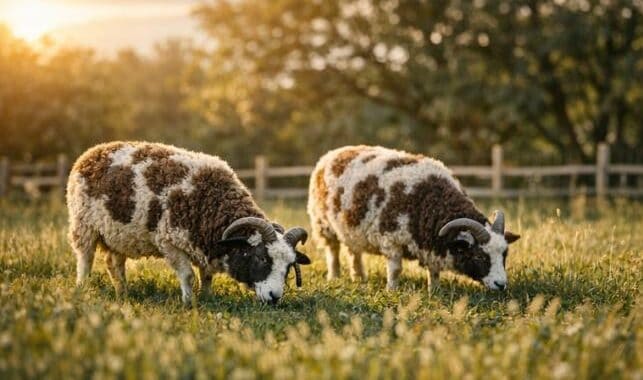
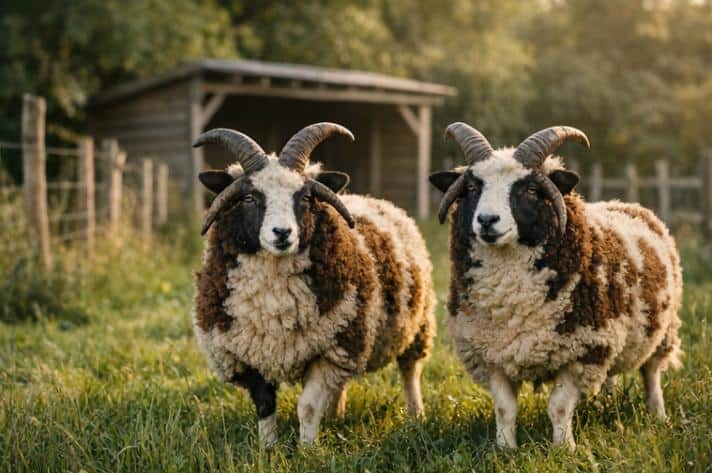
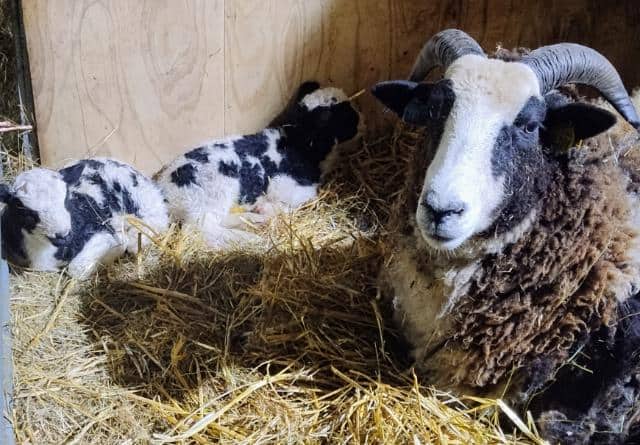
image3

Two Jacobs, Half an Acre

A beginner’s guide to keeping sheep in a small space

You’ve probably thought it. Maybe at a county show, watching a pair of Jacob sheep blink their golden eyes at you through the fence. Maybe on a walk past a smallholding where a little flock was doing absolutely nothing in particular, and doing it beautifully. The thought goes something like: “I’d love that. But I’m not a farmer. I don’t have the land.”

Here’s the thing: Jacob sheep don’t know what a farm is. They’ve never heard of it. They just want grass, company, and the occasional scratch behind the ear. And if you have half an acre and a bit of patience, that’s genuinely enough to get started.

Start with two wethers, not a breeding flock

This is the bit most beginner guides skip over, and it makes everything harder than it needs to be. The classic mental image of “keeping sheep” involves ewes, a ram, lambing season, and a lot of sleepless nights in February. You can absolutely do that — eventually — but it’s not where you need to start.

Start with two wethers. A wether is a castrated male, and they are, in the nicest possible way, completely uncomplicated animals. No breeding decisions. No lambing. No ram behaviour to manage. Just two calm, curious, characterful sheep learning to trust you and getting on with the important business of grazing.

Jacob wethers in particular are brilliant for this. The breed is hardy, small-framed, and well-suited to the kind of mixed, slightly scrubby grazing you’re likely to have on a small plot. They’re also striking to look at — those bold brown-and-white patches, the dramatic multi-horns — which matters more than people admit when you’re trying to convince yourself and others that this is a sensible idea.

What half an acre actually looks like

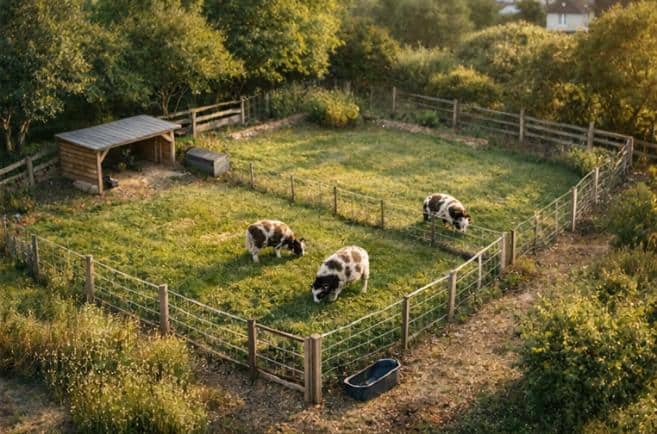
Half an acre is roughly the size of a large suburban garden — maybe 40 by 55 metres, if that helps. Picture it. Now picture two medium-sized sheep in it. That’s not crowded. That’s fine.

You’ll need stock fencing they can’t push through, a simple field shelter with good airflow (nothing elaborate — three sides and a roof is genuinely sufficient), a trough they can’t tip over, and access to fresh water at all times. In summer, two Jacobs will keep half an acre looking tidy without any help from you. In winter, the grass stops growing and you’ll be supplementing with hay — plan for this from the start and it won’t catch you out.

If you can rotate between two paddocks, even small ones, the land will thank you. But plenty of people manage with a single well-managed area, rested when needed. Don’t let the perfect setup stop you from starting a good one.

.

The surprisingly short list of what you actually need

New keepers often spend months researching and end up with a list so long it feels impossible. So here, stripped back, is what you genuinely need before your sheep arrive:.

Secure fencing and potentially, a simple shelter. A clean water supply. Basic footcare tools (a pair of hoof clippers). A good vet who knows small ruminants (call them before you need them). And one person — a neighbour, a local smallholder, anyone — who’s kept sheep before and is willing to be your first phone call when something looks off.

That last one is worth more than any piece of equipment. The smallholding community is, on the whole, generous and practical. Find your person before your sheep arrive.

What you don’t need: an elaborate handling system, an expensive purpose-built shelter, specialist sheep software, or seventeen different supplements. All of those things exist, and some of them are useful later. Right now, they’re just obstacles.

.

What it actually feels like

There’s a particular moment that most sheep keepers remember. It usually happens somewhere in the second or third week. You’re doing the evening check — water, fence, general state of things — and you realise you’ve stopped worrying. The sheep are just there, grazing in the late light, unbothered. And you’re just watching them, equally unbothered.

Jacob sheep are not lapdogs. They’ll take their time trusting you, and that process is part of what makes it worthwhile. But once they do — once they hear your voice and amble over, once they have names and distinct personalities and strong opinions about which side you scratch — it’s quietly absorbing in a way that’s hard to explain to someone who hasn’t done it.

It also fits around ordinary life in a way that larger livestock doesn’t. Two wethers on half an acre don’t demand your whole day. They demand consistency — daily checks, regular foot inspections, attentiveness — but not sacrifice. You can have a job, a family, a life, and keep sheep. Plenty of people do.

The permission slip you were looking for

If you’ve read this far, the real question probably isn’t “Do I have enough space?” You’ve already worked out that you might. The real question is whether you’re allowed to do this. Whether it’s a serious enough endeavour to justify the fencing costs, the learning curve, the neighbours’ raised eyebrows.

You are. It is. Almost everyone who keeps sheep started with a small plot, no experience, and a nagging feeling they were probably being a bit ridiculous. Most of them would tell you it’s one of the better decisions they’ve made.

The sheep won’t care that you’re not a farmer. They just want company, grass, and the occasional scratch behind the ear. The rest you’ll figure out as you go.

BlueTongue1

Bluetongue Update Feb 2026

Although you may be hearing less about Bluetongue (BTV), the virus certainly hasn’t gone away.

As of 2/2/2026, there have been 289 cases in the UK and Ireland since July 2025, with all cases in all regions bar Scotland.

There has been a total of 262 cases of BTV – 3 in England, 21 in Wales, 4 in Northern Ireland and 1 in Southern Ireland. There has been 1 case of BTV – 8 in the Southwest.

In January of this year there have been a total of 28 confirmed cases of BTV-3 spread across the Southwest, Southern, Central and Northern regions.

A number of these cases include animals born with congenital defects or cases where BTV has been identified as the cause of abortion.

A reminder in sheep that bluetongue can cause the following signs:

ulcers and sore around the mouth and nose
discharge from the nose and eyes
swellings around the head and neck
lameness/ inability to stand due to foot pain often associated with heat and swelling at the coronary band.
Sudden death

The mild, wet winter means we are likely to see the virus has overwintered and this could cause a resurgence in cases as we get into the spring and summer months.

If you vaccinated last year, I would not hesitate in recommending you do so again, if you are still undecided as to whether to vaccinate I would recommend the risk assessment template that can be found using the following link.

https://ruminanthw.org.uk/wp-content/uploads/2025/02/BattleBluetongue-vaccine-decision-maker-tool-February-2025-.pdf

I understand the concerns surrounding the use of a new vaccine last season and there were a lot of myths surrounding its safety, but having used the vaccine for over a year now we as vets have a much better understanding of it.

Timing for effective protection: Protective immunity develops approximately three weeks postvaccination. To ensure optimal protection, animals should ideally be fully vaccinated by early May, or at least three weeks before the onset of the anticipated risk period (typically early June).
Vaccine safety and fertility: Evidence shows no indication that BTV vaccination adversely affects fertility in ewes or cows. In contrast, the reproductive impact of natural infection is substantial and clearly outweighs any theoretical risk associated with vaccination.
Breeding management – ewes: To protect conception and early pregnancy, vaccination should be completed at least three weeks before rams are introduced to the flock.
Use close to mating: There is no evidence that the vaccine itself affects fertility or pregnancy, and it may be safely administered to healthy rams and ewes up to the day before mating if required for disease control purposes.
Early pregnancy considerations: As with any management intervention, unnecessary stress should be avoided in early gestation. Where possible, handling, nutritional changes and routine treatments (including vaccination) should be minimised during the first five weeks after mating.
Duration of immunity and boosters: Manufacturers anticipate approximately 12 months of protection, although this is not yet formally stated on product datasheets. Annual boosters should be planned in line with recommended pre-risk-period timing.
General vaccine risk profile: As with all viral vaccines, administration in early or late pregnancy should be considered carefully, but this is not a risk unique to BTV vaccines and does not indicate a specific fertility concern.
Safety experience: Post-marketing experience indicates a strong safety – manufacturers report millions of doses administered with very low incidence of adverse events.

.

image4

The Winter Watch – January Lambing

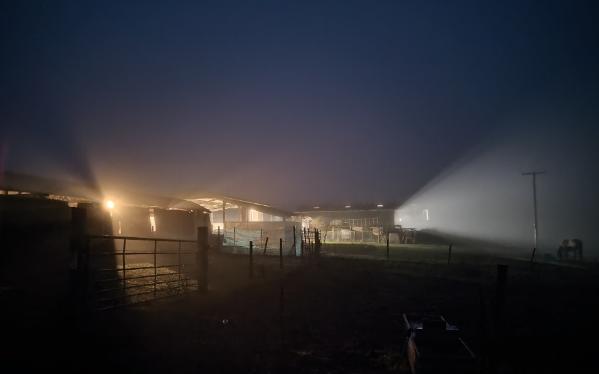
January lambing begins long before the first ewe settles into the straw. It starts in the quiet hours of the night when my mind begins to map the weeks ahead. I run through the checklist: the frost, the frozen pipes, the ground hard enough to bruise. Experience doesn't just teach you what to worry about—it teaches you how to prepare.

Early lambs are a gamble of the best kind. They grow strong on cold milk and short, sharp days. They carry a sturdiness that might one day command a show ring. That promise is what pulls us into the winter, into the frost and the ink-black nights. It’s a choice that feels both sensible and daring. Once the first gate clicks shut, the rhythm takes over.

The cold arrives with a bite that never leaves, and the work demands a specific kind of toughness. Fingers ache, and breath clouds the air, but there is a profound order to it. I bring the ewes inside, creating a sanctuary against the elements. Space, feed, bedding—every detail is a brick in the wall we build against the winter.

I ask the same questions every day, not out of fear, but out of a relentless commitment to the life in my care.


The work builds a steady momentum. One lamb, then another. The smell of colostrum and the steam from buckets become the atmosphere I breathe. Energy runs low, but purpose runs high. You keep moving because there is a deep, primal satisfaction in the plodding. You aren't just surviving the shift, you are seeing it through.

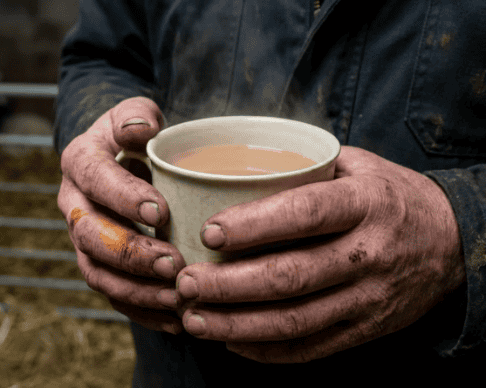
Sleep comes in fragments, but the two-o'clock silence has a magic all its own. I wait in the chill, watching a ewe circle and rise. When the timing is right, I step away for a fleeting moment. A hot mug warms my palms, the steam rising as I mentally sort the morning's tasks. The countryside is still, but the shed is alive. Rest is short, but it’s earned.

.

The rest of the world slows down. The housework can wait, the outside world feels distant. Within the family, we speak a shorthand of shared effort. One feeds, one checks, one keeps the hearth burning. Kindness isn't just a feeling here, it’s a deliberate act of service when the tank is near empty. We hold the line together.


Then, a single lamb demands everything. He’s slow to rise, his pulse a faint flicker. I lift him, guide him, and mix the bottles with steady hands. These small, gritty tasks bend the entire day around his survival. There is no ego in it, just the quiet, fierce intent to see him stand.

Success isn't a trophy; it’s the moment he no longer needs my help to thrive.

There are moments that demand a hard, clear focus. Breech births and unexpected triplets require steady hands and a temporarily locked heart. The emotion waits at the door so the work can get done. That distance isn't coldness—it’s the highest form of care. It’s what keeps the flock moving forward.

.

My body keeps the tally of the season. Iodine stains on my fingers, knees soaked through from the straw, the persistent chill in my joints. These aren't just marks of exhaustion; they are badges of being exactly where I was needed. I wear the work because the work matters.

Alongside the grit sits a genuine, electric excitement. New rams bring new potential. I see the future in the set of a lamb’s jaw or the strength of its bone.


Some answers please me, some teach me, but every single one improves the flock. We are building something that lasts.


By the end, the season loosens its grip. The boots stay by the door, but the urgency softens. You look out over the pens and see the transformation. Strong lambs stretch and jump, ewes chew with a rhythmic, peaceful calm. The "worry list" has been traded for a living, breathing reality.

.

Then comes the moment that makes the ache disappear. I stop and look—really look. The future is standing there on four unsteady, remarkable legs. New shapes, new hope, new life.


Is it worth the frozen pipes and the broken sleep?

Yes. Every single time. Because there is nothing quite like the feeling of standing in the dark with a torch and a bucket, knowing you are the bridge between the winter and the spring.

.

image6

Your 24-Hour Orphan Lamb Checklist

.

The first day determines the lamb’s survival. Use this checklist to stay on track during the critical 24-hour window.


Hour 0 to 2: Immediate Life Support

 Clear the airways: Remove mucus from the nose and mouth immediately.
 Dry the lamb: Use clean towels or a hair drier on a low setting. A wet lamb loses heat fast.
 Disinfect the navel: Dip the umbilical cord in a 10% iodine solution. This prevents “joint ill” and other infections.
 Check the temperature: If the lamb cannot hold its head up, check its rectal temperature. Use a warming box if it falls below 37°C.


Hour 2 to 6: The Antibody Window

 Administer first colostrum: Feed the lamb its first 200ml dose. Use a stomach tube if the lamb lacks a suckle reflex.
 Verify intake: Ensure the lamb’s belly feels slightly rounded but not hard.
 Monitor energy levels: A successful feed should result in the lamb attempting to stand or wiggle within 30 minutes.


Hour 6 to 12: Secondary Feedings

 Repeat colostrum feed: Give a second dose of colostrum. By the 12-hour mark, the lamb should have consumed roughly 150ml to 200ml per kilogram of its body weight.
 Observe behaviour: Watch for “starry-eyed” lambs or those standing alone in corners. These are signs of hunger or chill.


Hour 12 to 24: Stability and Transition

 Begin the transition: If you have no more colostrum, start introducing small amounts of lamb milk replacer.
 Provide a clean bed: Replace any soiled straw. Dry bedding is just as important as food.
 Prepare the record: Note the lamb’s weight, the time of its first feed, and any treatments given. Accurate records help you spot growth delays later.

.

.

How to Feed Colostrum Correctly

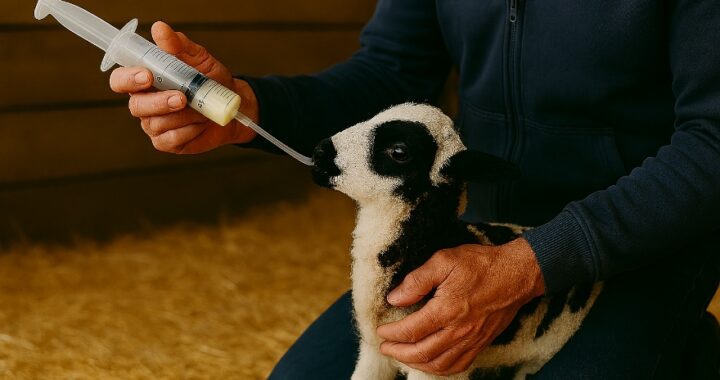
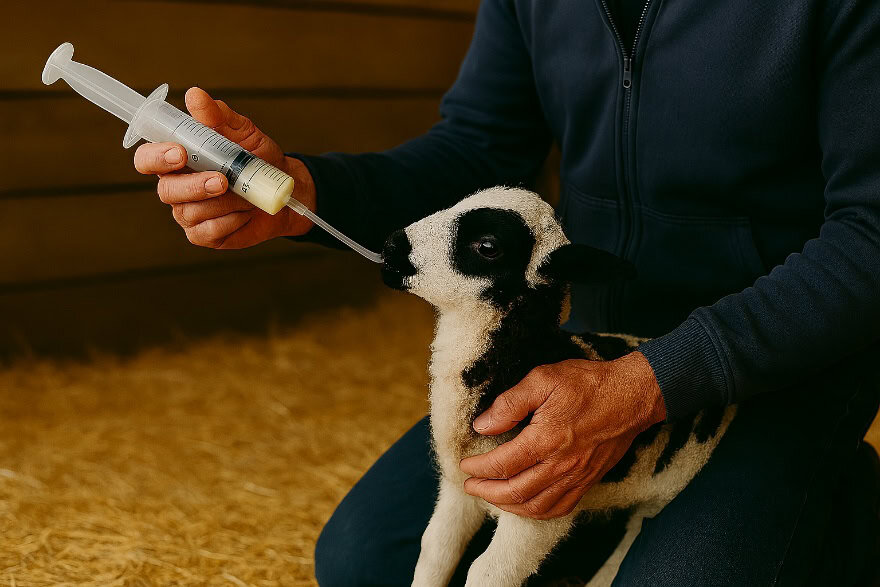
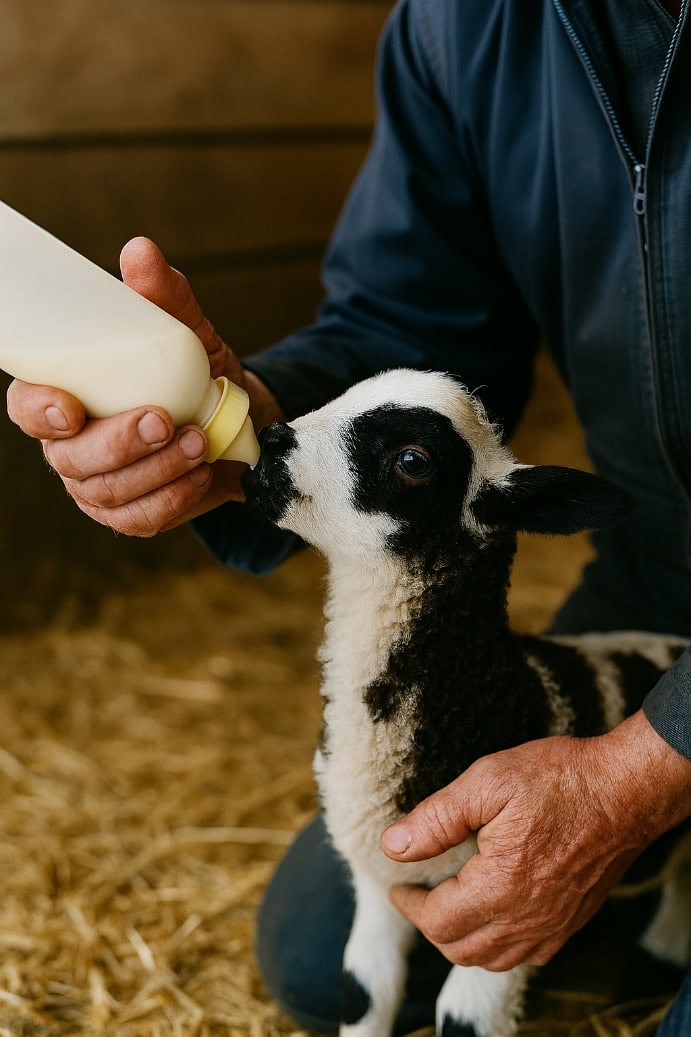
You must deliver colostrum to the lamb’s stomach as soon as possible. Most healthy lambs suckle from a bottle with a soft teat. If a lamb is too weak to suck, you must use a stomach tube.

Using a Stomach Tube

Position the lamb in a natural sitting or standing position. Between your calves is good, with you looking down on the lamb. Measure the tube from the lamb’s mouth to its last rib to ensure it reaches the stomach. Gently slide the tube over the tongue and down the throat. You will feel the tube pass easily.

If the lamb coughs or struggles violently, you likely entered the windpipe. Pull back and try again.

Once the tube is in place, attach the syringe and slowly depress the plunger.

.


Temperature and Volume

Feed colostrum at body temperature. Cold liquid shocks the lamb’s system and lowers its core temperature. Aim for 50ml per kilogram of body weight in the first feeding. A 4kg lamb needs 200ml of colostrum immediately after birth.


Practical Tips from Experienced Farmers

Farmers who successfully rear dozens of orphans every year rely on simple, repeatable tricks. These methods save time and keep mortality rates low.

.

Use the “Clean-finger” Rule

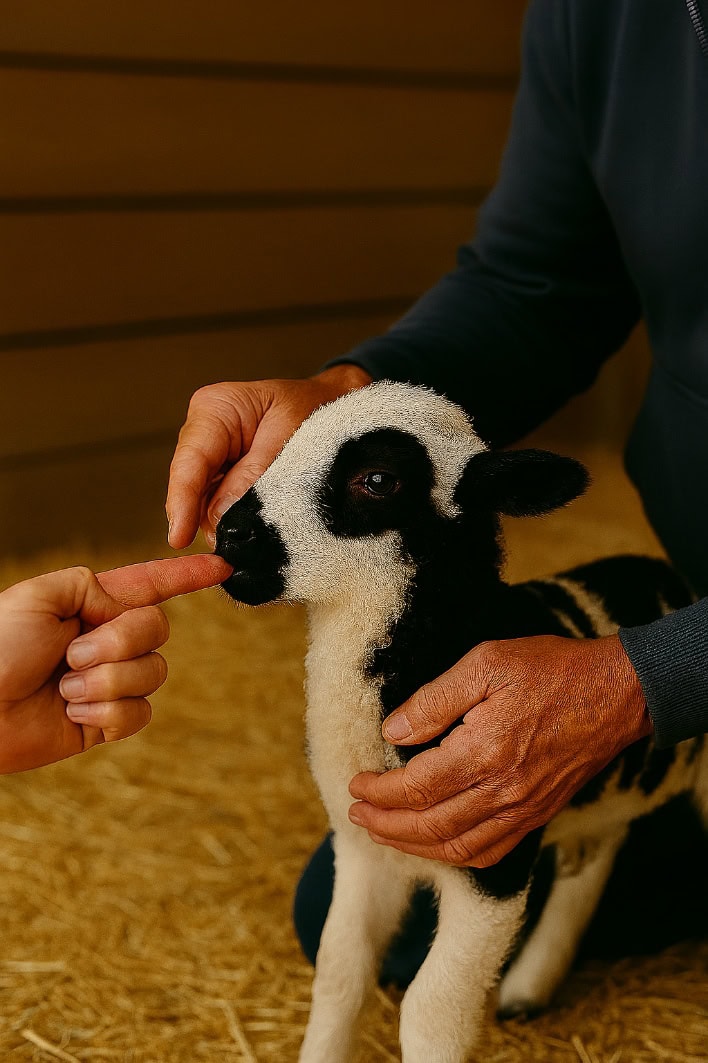
“Check the lamb’s mouth temperature with your ‘clean’ finger,” suggests veteran sheep farmer Mary Evans. “If the mouth feels cold, the lamb is hypothermic. Warm the lamb before you try to feed it, or the milk will just sit in the stomach.”.

.

Manage Group Dynamics

 Size Matching: Group lambs by size rather than age. This prevents larger lambs from bullying smaller ones at the feeder.
 The Mirror Trick: Hang a mirror in the pen if you only have one orphan. Lambs are social animals and seeing a “companion” reduces their stress levels
 Pop Bottles: Keep several clean plastic drinks bottles on hand. Standard lamb teats fit the threads of most 500ml bottles, making them cheap and replaceable containers
 Try not to treat them entirely like dogs. If you have multiple orphans, keep them together. Lambs are social and learn how to “be sheep” from each other, which makes weaning much easier.

image4

How to Successfully Rear Orphan Lambs

Rearing orphan lambs requires patience and a strict routine. You might find yourself with a “cade” lamb because of triplets, a rejected offspring, or a sick ewe. Success depends on acting fast during the first hours of the lamb’s life.

Provide Essential Colostrum

Colostrum is the first milk a ewe produces. It contains antibodies that build the lamb’s immune system. Lambs have no natural immunity when they arrive.

Why Timing Matters

You must feed colostrum within the first six hours after birth. A lamb’s gut closes to large antibody molecules after 24 hours. Data from 2024 shows that lambs receiving adequate colostrum have a 30% higher survival rate than those who do not.

Using Substitutes

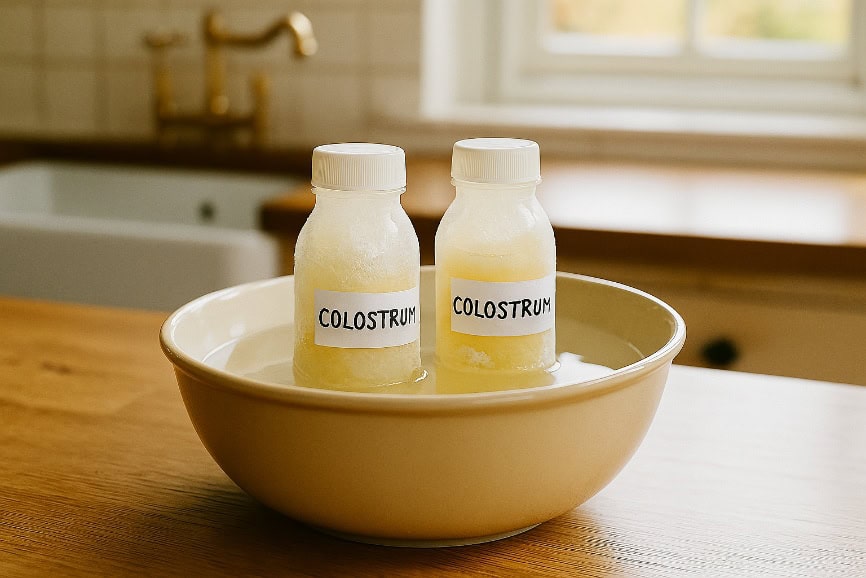
If the ewe cannot provide milk, use a high quality colostrum substitute. You can also use frozen colostrum from another ewe on your farm. Thaw frozen milk slowly in warm water. High heat destroys the vital antibodies.


.

.

Choose the Right Milk Replacer

Once the first 24 hours pass, you need a consistent milk source. Most farmers use a commercial lamb milk replacer. These powders provide the specific fat and protein levels a growing lamb needs.

.

Mixing Instructions

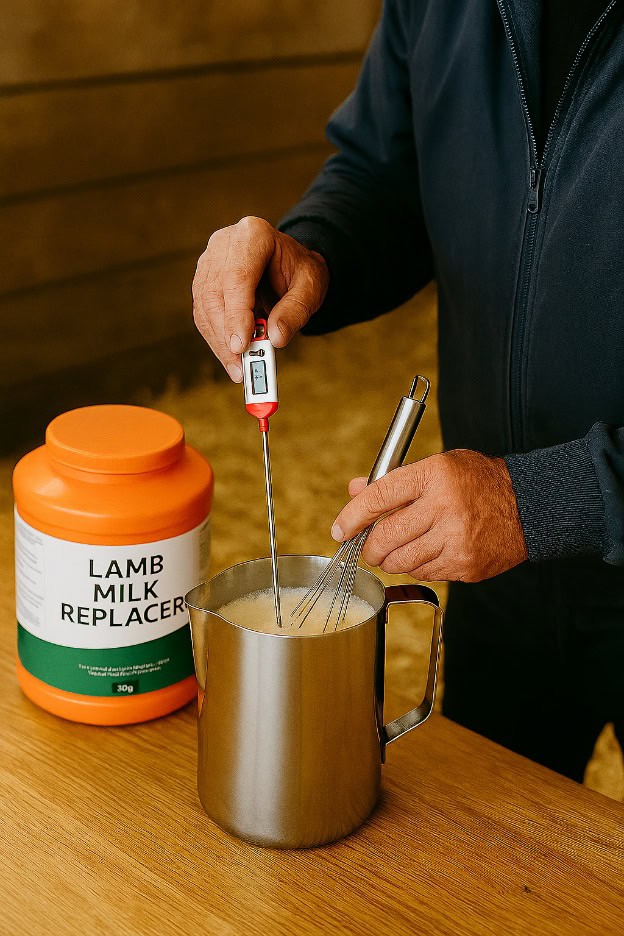
Follow the package instructions exactly. Too much powder causes constipation and bloat. Too little powder leads to malnutrition. Use a thermometer to ensure the milk reaches 39 degrees Celsius for bottle feeding.

.

.

Feeding Equipment

You can use individual bottles or an automatic feeder. Bottles allow you to monitor exactly how much each lamb drinks. Automatic feeders reduce your labour but require careful cleaning to prevent bacteria growth.

Establish a Feeding Schedule

Consistency keeps lambs healthy. Sudden changes in volume or timing cause digestive upset.

Frequency and Volume

Newborns need small, frequent meals. Start with four to five feedings per day. By week two, you can reduce this to three feedings. Increase the volume of milk as the lamb grows, but never overfeed in a single sitting. Overfeeding causes abomasal bloat, which is often fatal.

Transitioning to Solids

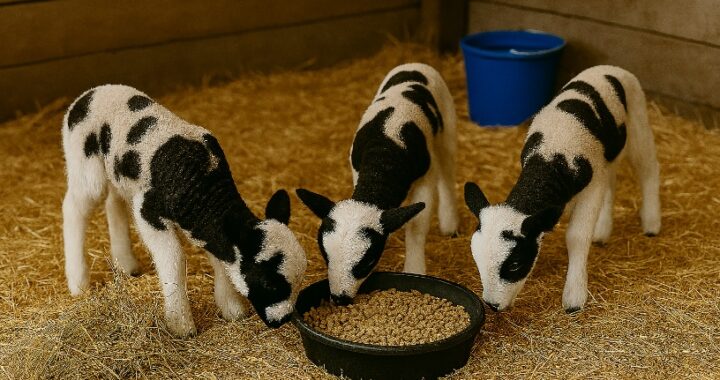
Introduce high protein creep pellets, some fine hay and fresh water from day seven. Even if they do not eat much at first, early exposure helps their rumen develop. “The rumen starts to function effectively only when the lamb begins consuming fermentable carbohydrates,” says livestock specialist Dr. John Wright.

.

Maintain a Clean Environment

Disease spreads quickly among young animals. You must keep the rearing area spotless.

Bedding and Ventilation

Use thick layers of clean straw. Damp bedding breeds bacteria and chills the lambs. Ensure good airflow in the shed without creating direct draughts. Cold draughts can lead to pneumonia.

Hygiene Protocols

Wash all bottles and nipples in hot soapy water after every use. Use a disinfectant to sterilise equipment daily. 2025 industry trends indicate that farms with strict hygiene protocols see a 15% reduction in antibiotic use.

Monitor Lamb Health

Watch your lambs closely for signs of illness. A healthy lamb is alert and has a dry tail area.

Common Problems

Scours and bloat are the biggest threats. If a lamb looks hunched or refuses milk, check its temperature. A normal temperature for a lamb stays between 38.8 and 39.5 degrees Celsius.

Image showing an alert lamb and one that is hunched with head drooped.

.

.

.

When to Wean

Most lambs are ready for weaning at 35 days old or when they weigh 15 kilograms. They must also eat at least 250 grams of solid pellets daily. Abrupt weaning is usually better for the lamb’s digestive transition than a gradual reduction in milk.

.

Frequently Asked Questions

How much milk does an orphan lamb need?

A lamb typically needs 10% to 15% of its body weight in milk daily, split into several feedings.

Can I give cow milk to a lamb?

Cow milk lacks the fat content lambs require. If you must use it, add one teaspoon of vegetable oil per 500ml, but switch to lamb replacer as soon as possible.

Why is my lamb’s stomach bloated?

Bloat often occurs from drinking too much milk too quickly or from bacteria in dirty bottles.

When should lambs start eating grass?

Lambs can nibble grass within their first two weeks, but they rely on milk and pellets for growth until weaning.

How do I keep an orphan lamb warm?

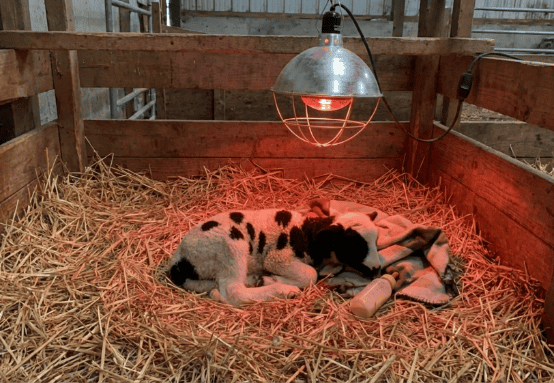
Use a heat lamp or a specialised lamb jacket if the temperature drops below 10 degrees Celsius.

.

.

Me and my Sheep

Not Your Grandad’s Sheep..!

A Modern Perspective on Jacobs: The Ultimate ‘Lifestyle’ Sheep for Young Land Managers

A black and white goat jumping over a log AI-generated content may be incorrect.If you’re picturing sheep-farming as a slow-paced, traditional pastime reserved for old-timers, think again. The world of small-scale agriculture is evolving rapidly, and so too are the sheep breeds best suited to modern lifestyles. Enter the Jacob sheep: a dynamic, heritage breed that is redefining what it means to manage livestock on a limited acreage. For young people with five acres and a strong internet connection, keeping Jacobs isn’t just about maintaining a few animals for the fun of it—it’s about intelligently managing a high-output, carbon-positive asset that excels where larger, commercial breeds often struggle.

The Low-Input Alpha: Resilient, Efficient, and Strategic

Jacobs are the ultimate “hack” for today’s small-scale land manager. Unlike the heavy, high-maintenance commercial hybrids that can quickly exhaust both your patience and your pockets, Jacob sheep stand out for their adaptability and resilience. They thrive on upland pastures, making them ideal for marginal land that might otherwise go underused. Their natural resistance to foot rot and common parasites means you’ll spend far less on chemical treatments, giving you more freedom to focus on thoughtful flock management and rotational grazing strategies, rather than reactive problem-solving.

The Aesthetic Return On Investment: Beyond the Commodity Market

In today’s world, the value of livestock isn’t measured solely by the price of meat or wool on a commodity market. The distinctive piebald fleece of the Jacob sheep is not just visually striking—it’s a sought-after raw material with full British wool traceability, highly prized in the artisan and craft sectors. This traceability and uniqueness allow individual producers to command a premium, both for raw fleece and finished products.

 Pedigree and Resale Value: Multi-horned Jacob sheep are in demand for their pedigree status, increasing the market value of breeding stock and attracting buyers from specialist circles.
 Marketable Markings: The dramatic, high-contrast markings of Jacobs create natural differentiation, making “field-to-fabric” branding opportunities a breeze. These eye-catching visuals generate organic social media buzz, helping you tell your story and build your brand online.
 Premium Meat Markets: Heritage genetics give Jacob lamb a lean, fuller flavour profile that appeals to niche consumers and commands higher prices per kilo compared to standard supermarket lamb.

A sweater with a tag on it AI-generated content may be incorrect.

Precision Conservation: Active Guardianship of Rare Breeds

Owning a flock of Jacobs is about more than just aesthetics or profit—it’s a conscious commitment to rare breed conservation. As a custodian of this breed, you play an important role in upholding specific breed standards and avoiding the genetic bottlenecks that threaten biodiversity. This is not passive ownership; it’s an active, hands-on approach to conservation. Jacobs act as natural “lawnmowers,” maintaining delicate habitats without causing soil compaction or damage often associated with heavier animals or machinery. In this way, your management efforts directly contribute to the health of local ecosystems.

The Live-Action Audit: Strategic Land Use and Flock Benchmarking

Ready to make the most of your land and flock? Begin by surveying your property. Walk the boundaries and take careful note of “marginal” areas—those overgrown banks or patches of scrub that conventional sheep might overlook. Jacobs, with their inquisitive and athletic nature, are adept at browsing these otherwise wasted spaces. Consider mapping out a three-paddock rotation system that takes full advantage of the Jacob’s versatility, improving your soil health, and increasing your overall land productivity.

Choosing Jacob sheep is a forward-thinking, multifaceted investment—one that pays dividends not only in terms of aesthetics and profit, but also in environmental stewardship and the preservation of agricultural heritage. It’s time to leave the old stereotypes behind and embrace the new era of sheep farming, where innovation, conservation, and community walk hand in hand—right alongside your flock.

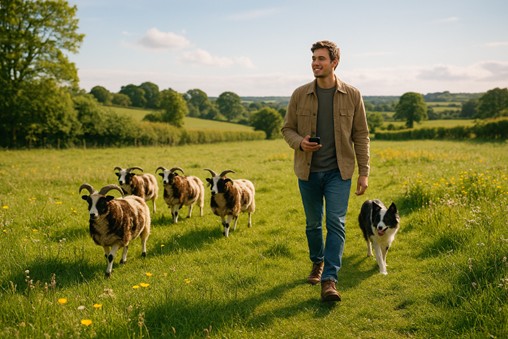
A person walking a herd of sheep AI-generated content may be incorrect.

Winter 2025

EASTERN REGION – Regional Contact Member – Tom Green

Summer continued to be dry in the east with many members having to feed sheep over summer, hopefully now in September the weather has broken, and the grass has freshened up a bit for everyone.

First, I would like to offer the regions huge congratulations to Joe Trofer-Cook who reached the final three in the British Farming Awards for the Kaleb Cooper New Entrant Award. This followed on from Joe taking the reserve championship in the Young Handlers at the Great Yorkshire Show following a win in the oldest section, and his brother Ernie also won the youngest section meaning two of the three brothers were in the championship.

The Eastern show season continued at Heckington where John Dixon presided over the judging. Richard Chapman’s Churchland aged ewe was John’s champion on the day. This first crop ewe is a Churchland Samuel daughter and was champion as a shearling at Hope Show in 2024. She had to fight off stiff competition from David and Charlie Coe’s Wenham shearling ewe who took reserve. This one sired by Celtic Picasso was champion at Suffolk and the Royal Norfolk and had been destined for the sale at Melton Mowbray the previous year until BTV restrictions prevented it from coming. I was rather pleased to take the red rosette in the ewe lamb class with my pretty Border Bugler daughter out of a homebred dam by my own Chestnut Yellerbelly, this ewe lamb comes from my Fineshade line. In the male classes Joe Trofer-Cook won the ram class with Fenland Oh -Eck, a 4-horn shearling by Hope Diamond. Tracey and Martin Coates won the ram lamb class with Ahmere Brandon, a Beiliau Lancaster son. Jacob classes again featured at Leicestershire County Show on August Bank Holiday weekend; we were very grateful to Jean Simmons for stepping in to judge at the last minute. The classes were well supported by both Central and Eastern Region members alike. Congratulations to Jane and Alan Nightingale who took championship with their Firtree shearling ewe and Kay and Sean Carpenter who took reserve with their Lickhill ewe lamb. The Carpenters also won the ram lamb class with Lickhill Perdix. Thank you to Tracey and Martin Coates, Fenella Bellinger, Helen Wright and Charlotte Lamb for supporting the classes and it would be great to get more exhibitors here next year. Special mention to young shepherd, Sam Wright, who took 1st prize in the Young Handlers with his Mum’s Valeland Ram lamb.

I would like to wish members who have purchased from the shows and sales huge amounts of luck with their purchases. I’d like to congratulate Tracey and Martin who bought the reserve male champion, Beiliau Captain, and 2nd placed Beiliau shearling ewe at Worcester.

Onto our own sale at Melton Mowbray, I will refer you all the full sale report written elsewhere but I would like to thank all exhibitors and purchasers. Congratulations go to Charlie and David Coe on winning champion and reserve with their ram and ewe lambs respectively. Jane and Alan Nightingale who had the reserve male champion and Lisa

Adams who had the reserve female. I would like to thank Wyn Harries and Clive Richardson for inspecting and Jean Simmons for her stewarding and adjudicating and giving up their long weekend, without their support the Show and Sale wouldn’t be possible. Thanks as well go John Fozzard for judging. Twenty-two members and families enjoyed a great presale meal at an Italian Restaurant in Melton Mowbray and a great time was had by all.

I would like to welcome our new members Nick and Rebecca Kiddy and wish them well with their Jacobs.

The Eastern Region AGM and Christmas meal will again be held at The Bell Inn, Stilton on the 23rd of November.

In my own flock all ewes have now been tupped with only a handful of returns from the sponges and I look forward to the progeny from the seven tups (yes seven, my father despairs) I used this autumn at the end of January. It’s a quiet time for the flock with retained lambs being given a clear out drench for worms and just a couple of ram lambs of both breeds we keep pedigree to halter train. Ewes are away at grass now the rams are out and will be given energy and protein buckets for the last eight weeks of pregnancy with concentrate feed introduced around Christmas time.

I wish everyone a Happy Christmas and New Year and good luck at lambing time. I can be contacted in the meantime on or on 07800 817850

Winter 2025

WALES REGION – Regional Contact Member – Alison Ross

The warm dry summer seems a distant memory as I look back to my five day commute over the Epynt to attend the Royal Welsh Show. The Mynydd Epynt is a large tract of land to the north of the Bannau Brycheiniog (Brecon Beacons) National park. In 1940 200 people from 54 farms were evicted in order to make way for a military training ground.

I was witness to some breath-taking views as an early start would often treat me to swirling mists of “ Dragon’s Breath” in the valleys, while the sun broke through on the tops of the hills creating an other-worldly atmosphere.

The Royal Welsh Show is Wales’ flagship agricultural show attracting big names in the farming community and we are lucky to have some well- established and highly thought of Jacob flocks who regularly attend the show. This year was a particularly difficult time with Blue Tongue restrictions meaning only flocks based in Wales could enter so it was gratifying to see how many members attended both to participate and to lend support. It also gave some newer members a chance to rise and shine in the line-up. All the classes had a good entry of quality sheep to keep our judge, Lyn Jones, busy. The JSS Boraston Shield for best group of three was won by Gwenllian Evans, and the best male exhibit was James Leonard’s four horn shearling ram. The best female exhibit was the Harries’ family’s four horn shearling ewe which went on to win the JSS perpetual trophy as champion with James Leonard’s four horn shearling tup taking reserve. Many thanks to Lyn for judging. In the RWAS young handlers competition, Sara Harries came 1st out of 23 entries in her class and Lois Harries came 2nd out of 30 in her class. Well done to both of them.

The Wales Region Show and Sale at Monmouth Livestock Centre was also hampered by the Blue Tongue restrictions (incidentally lifted the day after the sale). However a moderate entry of 55 sheep was ably judged by Hayley Higginson and then auctioned by Lyndon Trumper to an almost 100% clearance. Female champion and overall champion was awarded to the Trumper family and their lovely two horn shearling ewe with the reserve championship awarded to the Harries family’s two horn ram lamb. Top prices of 600gns went to a Beiliau ewe lamb, 520gns to a GJ ewe lamb, 500gns to a Madog ewe lamb, and 400gns to a Penni Bach four horn ewe lamb

It is with great sadness that the RWAS has decided to end the Spring Show formerly known as The Smallholders and Countryside Show. Many of us will be very disappointed to hear this news. We will have to look for another show for our JSS breed promotion stand.

I would like to extend my gratitude to so many Welsh members and our visiting judges, who have helped at shows, the sale and behind the scenes in what has been a difficult year for all of us. You know who you are and I hope you know you are not taken for granted. As is often said, team work makes the dream work.

Winter 2025

SOUTHERN REGION – Regional Contact Member – Peter Gorringe

It has been a great year for support from Southern Region members starting the year with a lambing open day at the Shutecombe flock with guest speaker, Ellie, an experienced shepherdess who teaches at Plumpton College followed by lunch afterwards at a local pub.

In June the Hallwood flock hosted a trimming for shows day which was well attended by members with positive response. An enjoyable walka round the farm and a pub lunch completed the day.

In September we held a flock competition with twelve flocks entering from across the region. In

November the Albans flock will host an open day with a talk on organic fly sprays.

The shows in the region have been well attended with good entries in the Jacob sheep classes which was great to see. Wendy Sharp attended the Edenbridge and Oxted Show and writes: “This year at the Peter Gorringe’s champion ram lamb and Wendy Sharp’s Edenbridge & Oxted reserve champion shearling ewe

Show, my team and I had the pleasure of bringing along eight of my Jacob sheep flock, four rams and four ewes for a weekend of great weather, great competition and great fun, along with a great celebration of rural life. The turnout this year was impressive and it was a wonderful chance to meet other passionate shepherds and exchange breeding tips. Getting the sheep show-ready was a task in itself. Days beforehand, my team had carefully washed and trimmed their fleeces and on the morning of the show, we gave them a final brush and polish. When our judge, Gareth Jones was ready, we started with the ram classes, and my rams looked as good as they could, shown by Vicky , Lexie and Gracie in turn. Mixed results were received with very tough competition. Then the females turn with shearlings first and then ewe lambs, shown by Vicky and I. Better results here with some first prizes enabling us to go into the championship. We entered the championship with a ewe lamb and a shearling ewe, and landed reserve champion Jacob sheep with the shearling. Good result and worth all the hard work… but room for improvement always. While the showing was the main event, what stood out was the atmosphere of shared enthusiasm. Families wandered past the pens, fellow exhibitors stopped by for a chat, and there was a real sense of community. Leaving the show, I felt a deep sense of satisfaction. The experience was invaluable for showcasing my animals and for strengthening the bonds within the Jacob sheep community. I’ll certainly be back next year to celebrate again.”