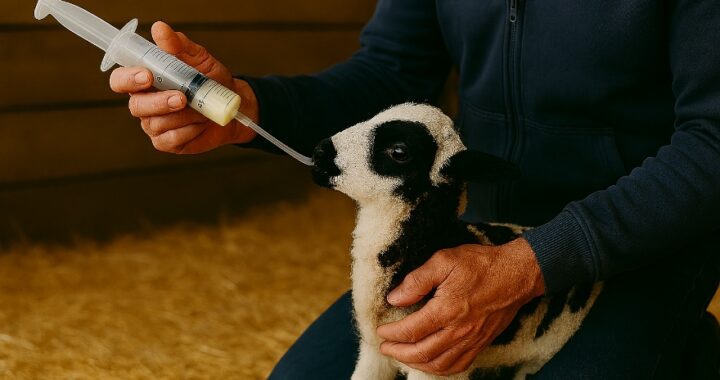
.
The first day determines the lamb’s survival. Use this checklist to stay on track during the critical 24-hour window.
Hour 0 to 2: Immediate Life Support
• Clear the airways: Remove mucus from the nose and mouth immediately.
• Dry the lamb: Use clean towels or a hair drier on a low setting. A wet lamb loses heat fast.
• Disinfect the navel: Dip the umbilical cord in a 10% iodine solution. This prevents “joint ill” and other infections.
• Check the temperature: If the lamb cannot hold its head up, check its rectal temperature. Use a warming box if it falls below 37°C.
Hour 2 to 6: The Antibody Window
• Administer first colostrum: Feed the lamb its first 200ml dose. Use a stomach tube if the lamb lacks a suckle reflex.
• Verify intake: Ensure the lamb’s belly feels slightly rounded but not hard.
• Monitor energy levels: A successful feed should result in the lamb attempting to stand or wiggle within 30 minutes.
Hour 6 to 12: Secondary Feedings
• Repeat colostrum feed: Give a second dose of colostrum. By the 12-hour mark, the lamb should have consumed roughly 150ml to 200ml per kilogram of its body weight.
• Observe behaviour: Watch for “starry-eyed” lambs or those standing alone in corners. These are signs of hunger or chill.
Hour 12 to 24: Stability and Transition
• Begin the transition: If you have no more colostrum, start introducing small amounts of lamb milk replacer.
• Provide a clean bed: Replace any soiled straw. Dry bedding is just as important as food.
• Prepare the record: Note the lamb’s weight, the time of its first feed, and any treatments given. Accurate records help you spot growth delays later.
.
.
How to Feed Colostrum Correctly
You must deliver colostrum to the lamb’s stomach as soon as possible. Most healthy lambs suckle from a bottle with a soft teat. If a lamb is too weak to suck, you must use a stomach tube.
Using a Stomach Tube
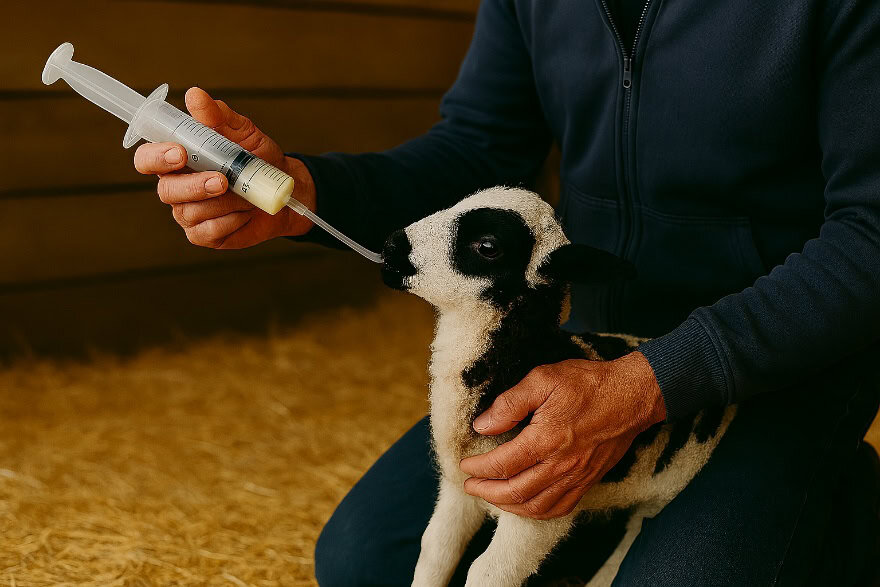 Position the lamb in a natural sitting or standing position. Between your calves is good, with you looking down on the lamb. Measure the tube from the lamb’s mouth to its last rib to ensure it reaches the stomach. Gently slide the tube over the tongue and down the throat. You will feel the tube pass easily.
If the lamb coughs or struggles violently, you likely entered the windpipe. Pull back and try again.
Once the tube is in place, attach the syringe and slowly depress the plunger.
.
Temperature and Volume
Feed colostrum at body temperature. Cold liquid shocks the lamb’s system and lowers its core temperature. Aim for 50ml per kilogram of body weight in the first feeding. A 4kg lamb needs 200ml of colostrum immediately after birth.
Practical Tips from Experienced Farmers
 Farmers who successfully rear dozens of orphans every year rely on simple, repeatable tricks. These methods save time and keep mortality rates low.
.
Use the “Clean-finger” Rule
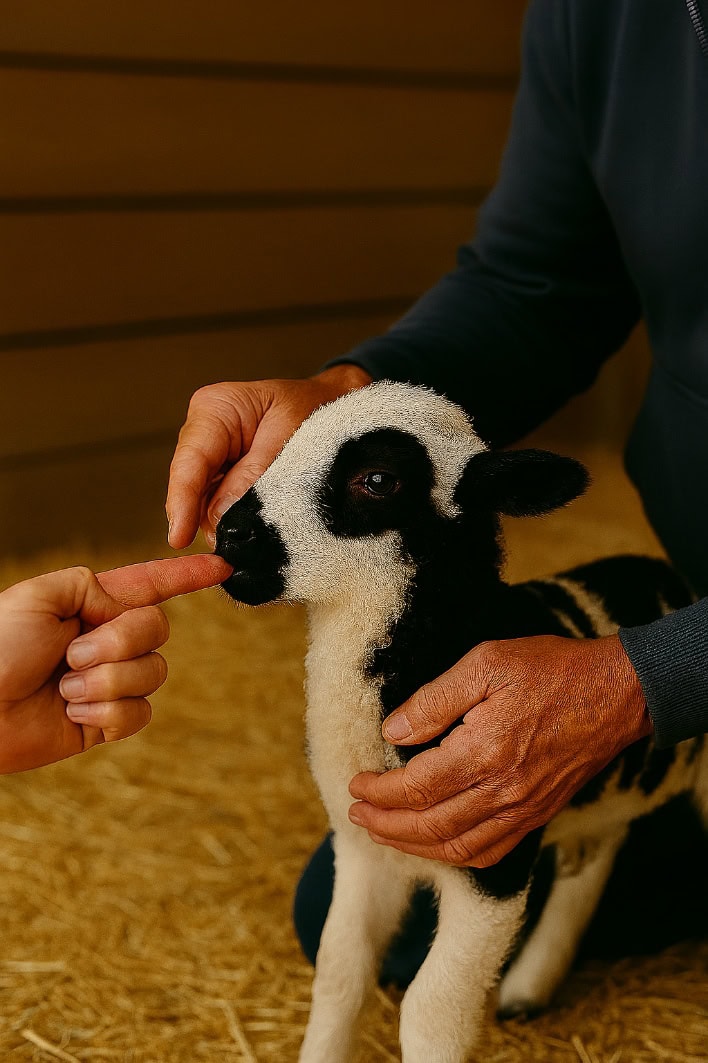
“Check the lamb’s mouth temperature with your ‘clean’ finger,” suggests veteran sheep farmer Mary Evans. “If the mouth feels cold, the lamb is hypothermic. Warm the lamb before you try to feed it, or the milk will just sit in the stomach.”.
.
Manage Group Dynamics
• Size Matching: Group lambs by size rather than age. This prevents larger lambs from bullying smaller ones at the feeder.
• The Mirror Trick: Hang a mirror in the pen if you only have one orphan. Lambs are social animals and seeing a “companion” reduces their stress levels
• Pop Bottles: Keep several clean plastic drinks bottles on hand. Standard lamb teats fit the threads of most 500ml bottles, making them cheap and replaceable containers
• Try not to treat them entirely like dogs. If you have multiple orphans, keep them together. Lambs are social and learn how to “be sheep” from each other, which makes weaning much easier.