
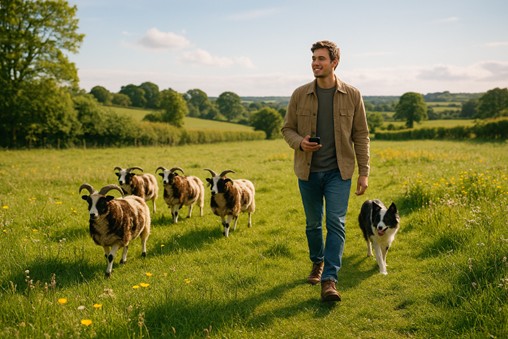
A Modern Perspective on Jacobs: The Ultimate ‘Lifestyle’ Sheep for Young Land Managers
 If you’re picturing sheep-farming as a slow-paced, traditional pastime reserved for old-timers, think again. The world of small-scale agriculture is evolving rapidly, and so too are the sheep breeds best suited to modern lifestyles. Enter the Jacob sheep: a dynamic, heritage breed that is redefining what it means to manage livestock on a limited acreage. For young people with five acres and a strong internet connection, keeping Jacobs isn’t just about maintaining a few animals for the fun of it—it’s about intelligently managing a high-output, carbon-positive asset that excels where larger, commercial breeds often struggle.
The Low-Input Alpha: Resilient, Efficient, and Strategic
Jacobs are the ultimate “hack” for today’s small-scale land manager. Unlike the heavy, high-maintenance commercial hybrids that can quickly exhaust both your patience and your pockets, Jacob sheep stand out for their adaptability and resilience. They thrive on upland pastures, making them ideal for marginal land that might otherwise go underused. Their natural resistance to foot rot and common parasites means you’ll spend far less on chemical treatments, giving you more freedom to focus on thoughtful flock management and rotational grazing strategies, rather than reactive problem-solving.
The Aesthetic Return On Investment: Beyond the Commodity Market
In today’s world, the value of livestock isn’t measured solely by the price of meat or wool on a commodity market. The distinctive piebald fleece of the Jacob sheep is not just visually striking—it’s a sought-after raw material with full British wool traceability, highly prized in the artisan and craft sectors. This traceability and uniqueness allow individual producers to command a premium, both for raw fleece and finished products.

Precision Conservation: Active Guardianship of Rare Breeds
Owning a flock of Jacobs is about more than just aesthetics or profit—it’s a conscious commitment to rare breed conservation. As a custodian of this breed, you play an important role in upholding specific breed standards and avoiding the genetic bottlenecks that threaten biodiversity. This is not passive ownership; it’s an active, hands-on approach to conservation. Jacobs act as natural “lawnmowers,” maintaining delicate habitats without causing soil compaction or damage often associated with heavier animals or machinery. In this way, your management efforts directly contribute to the health of local ecosystems.
The Live-Action Audit: Strategic Land Use and Flock Benchmarking
Ready to make the most of your land and flock? Begin by surveying your property. Walk the boundaries and take careful note of “marginal” areas—those overgrown banks or patches of scrub that conventional sheep might overlook. Jacobs, with their inquisitive and athletic nature, are adept at browsing these otherwise wasted spaces. Consider mapping out a three-paddock rotation system that takes full advantage of the Jacob’s versatility, improving your soil health, and increasing your overall land productivity.
Choosing Jacob sheep is a forward-thinking, multifaceted investment—one that pays dividends not only in terms of aesthetics and profit, but also in environmental stewardship and the preservation of agricultural heritage. It’s time to leave the old stereotypes behind and embrace the new era of sheep farming, where innovation, conservation, and community walk hand in hand—right alongside your flock.
